



Vision

To excel as a centre of Technical Excellence in the field of Electronics and Communication Engineering.

Mission

To nurture the young minds with quality technical education and skills by adopting Learner-Centric approaches in the field of Electronics and Communication Engineering.
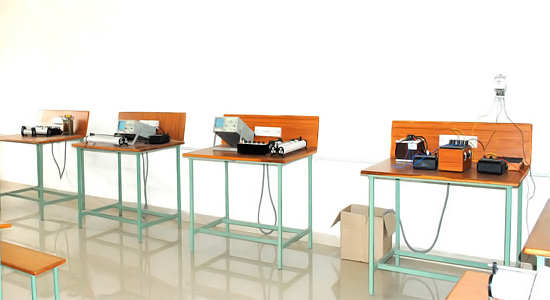
ECE Laboratory
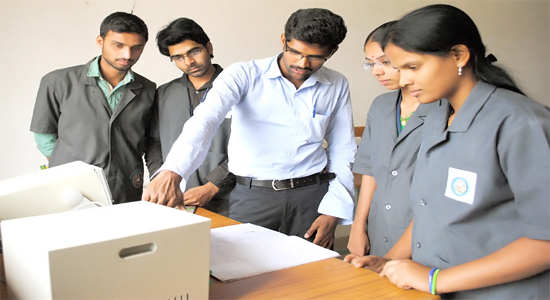
ECE Students and Faculty

Program Educational Objectives (PEOs)

  • To provide the students with a strong foundation in the required sciences in order to pursue studies in Electronics and Communication Engineering.
  • To gain adequate knowledge to become good professionals in electronic and communication engineering associated industries, higher education, and research.
  • To develop attitude in lifelong learning, applying, and adapting new ideas and technologies as their field evolves.
  • To prepare students to critically analyze existing literature in an area of specialization and ethically develop innovative and research-oriented methodologies to solve the problems identified.
  • To inculcate in the students a professional and ethical attitude and an ability to visualize engineering issues in a broader social context.

Program Specific Outcomes (PSOs)

  • PSO1: Design, develop and analyze electronic systems through application of relevant electronics, mathematics and engineering principles.
  • PSO2: Design, develop and analyze communication systems through application of fundamentals from communication principles, signal processing, and RF System Design & Electromagnetics.
  • PSO3: Adapt to emerging electronics and communication technologies and develop innovative solutions for existing and newer problems.

Role of Electronics & Communication Engineer

Electronics and Communication Engineers are integral to the development and maintenance of modern technology. Their contributions span from the initial concept to the final product, ensuring functionality, reliability, and compliance with industry standards. Here is a comprehensive overview of their key roles and responsibilities:

  • Engage with clients to discuss and refine proposals.
  • Design new systems, circuits, and devices or enhance existing technologies.
  • Innovate and refine existing circuits and systems to enhance performance and efficiency.
  • Conduct testing of theoretical designs.
  • Write detailed technical reports and specifications.
  • Develop user-friendly interfaces & Ensure compliance with safety regulations.
  • Plan, manage projects, and prepare budgets.
  • Systematically improve the design and details of electronic equipment.

By integrating these roles and responsibilities, Electronics and Communication Engineers ensure that technology meets the demands of a rapidly evolving world, making them indispensable in sectors including telecommunications, healthcare, defense, and IT.

Career Prospects

The graduates of ECE can look forward to a promising future with opportunities in various roles across diverse industries:

  • Roles: Electronics Engineer, Electronics and Communication Engineer, Electronics Design & Development Engineer, Desktop Support Engineer, and System Control Engineer.
  • Industries include: Robotics, Automotive, Telecommunications, and Electronic Equipment Manufacturers.
  • Emerging Fields: ECE graduates can explore opportunities in fields such as IoT, Artificial Intelligence (AI), and 5G/6G technology development.
  • Research roles: Are available in both academic and commercial establishments.
  • Public sector: Civil Service, Local Authorities, Hospitals, and Educational Institutions.
  • Government Departments: Ministry of Defence, Telecommunication departments.
  • Collaboration: Collaborate with experts from software, mechanical, and data science fields.

SALIENT FEATURES

  • Comprehensive training in VLSI design, Embedded Systems, and Communication.
  • Hands-on hardware prototyping and PCB fabrication lab sessions.
  • Regular workshops on Robotics, Internet of Things (IoT), and 5G Communications.
  • Well-established collaborations with core electronics and telecom industries.
  • Focus on research-driven learning and real-world system designs.

LAB FACILITIES

State-of-the-art laboratory infrastructure equipped with original apparatus and modern setups.

Microprocessor & Embedded Lab
Communication Systems Lab

STUDENT ACHIEVEMENTS

  • Developed a smart campus autonomous robot for surveillance.
  • Multiple papers co-authored and presented in international IEEE conferences.
  • Winners of inter-collegiate robotics and micro-controller design contests.

STAFF ACHIEVEMENTS

  • Granted 3 national patents in smart agricultural sensor networks.
  • Completed consultancy projects worth substantial industrial funding.
  • Active reviewers for leading international electronics journals.

Faculty Profiles

S.No. Name Faculty Type Designation
1 Dr. JEYARANI A D Regular Asst. Prof.
2 Mrs. JANET SOPHIA M Regular Asst. Prof.
3 Mrs. SURYA L Regular Asst. Prof.
4 Mrs. SHAMILI R Regular Asst. Prof.
5 Ms. SUMATHI A Regular Asst. Prof.
6 Mrs. LILLY K PAULINE Regular Asst. Prof.
7 Mrs. TREPHENA PATRICIA A Regular Asst. Prof.
8 Mrs. ARUL ANGELINE A Regular Asst. Prof.
9 Ms. WALANTINA E Regular Asst. Prof.
10 Mr. PADMANATHAN T Regular Asst. Prof.

Our Recruits & Placements

Our graduates are placed in leading global and national enterprises.

Company Logo Company Logo Company Logo Company Logo Company Logo Company Logo Company Logo Company Logo Company Logo Company Logo Company Logo Company Logo